About this research

NAGAI Takeharu
- SANKEN (The Institute of Scientific and Industrial Research)
- Professor

Viruses hijack the intercellular "conversation" to spread infection
Discovered a new influenza infection mechanism, expecting for drug development
- Discovered that neighboring uninfected cells receive messages from the first infected cells.
- Uninfected cells which received messages become susceptible to infection, accelerating the spread of the virus to the neighboring area.
- New concepts of drug development/treatment targeting message exchange will be expected.
Outlines
A research group including Associate Professor Yoichiro Fujioka, Fumiya Kozawa, and Professor Yusuke Ohba of the Hokkaido University Graduate School of Medicine, Professor Takeharu Nagai of the SANKEN (The Institute of Scientific and Industrial Research) who also serves as head of the Institute for Open and Transdisciplinary Research Initiatives, and Associate Professor Tomokazu Tamura and Professor Takasuke Fukuhara of the Kyushu University Graduate School of Medical Sciences, has discovered that influenza viruses hijack the intercellular "conversation" as they spread within the body. This discovery is expected to develop new treatments to suppress viral infections.
Viral infection initially infects a few host cells before spreading to neighboring cells. However, the detailed mechanisms underlying this dissemination were not well understood.
The research group has previously found that increased intracellular calcium ion concentrations make cells more susceptible to influenza virus infection. In this study, the research group revealed by using a trans-scale imaging system (AMATERAS-1, a multiscale/modal analytical tool for every rare activity in singularity) and other instruments that virus-infected cells release adenosine diphosphate (ADP) outside the cells, and when this is received by neighboring cells, the intracellular calcium ion concentration increases. This phenomenon is called calcium wave propagation, and it spreads in a chain reaction to neighboring cells, like a game of Chinese Whispers. This research has revealed that the virus hijacks this calcium wave propagation mechanism, and accelerates infection. Furthermore, the research group also demonstrated that blocking the ADP receptor can stop the spread of this wave propagation and suppress infection.
The results of this research not only solve the mystery of how viruses spread within the body, but will also lead to the development of new antiviral drugs that target intercellular "conversation" in the future.
Figure: A message (ADP) is sent from the first infected cell to neighboring cells, causing an increase in the intracellular calcium ion (Ca²⁺) concentration. This leads to active infection of neighboring cells
Credit: Takeharu Nagai
Research Background
Viral infection initially infects a few host cells before spreading to neighboring cells and eventually causes a widespread infection. However, the detailed mechanisms underlying this dissemination were not well understood. The research group has previously found that increased intracellular calcium ion concentrations make cells more susceptible to virus infection.
Therefore, in this study, the research group focused on changes in intracellular calcium ion concentration and examined in detail how the virus increases the number of infected cells in the body.
Research Contents
Methods
The research group used a microscope capable of simultaneously observing hundreds of thousands to millions of cells at once to analyze how calcium ion concentrations in cells change when infected with a virus. They also examined whether drugs that suppress changes in calcium ion concentration can prevent the spread of viral infection.
Results
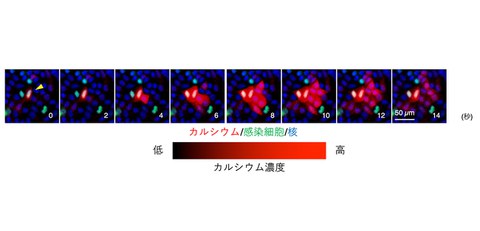
When changes in calcium ion concentration at the cell population level during virus infection were observed using AMATERAS, etc., the researchers discovered a phenomenon in which an increase in calcium ion concentration propagates like a wave from infected cells to neighboring cells (calcium wave propagation) (Fig. 1 and 2). It was clarified that the ADP released from infected cells is received by neighboring cells through ADP receptors, causing an increase in intracellular calcium ion concentrations.
In other words, infected cells and neighboring uninfected cells had conversations using ADP and ADP receptors.
Furthermore, they also found that treating the cells with a drug that blocks ADP receptors reduces infection. When the same drug was administered to mice, the suppression of infection was also confirmed, indicating that calcium wave propagation plays an important role in the spread of viral infection in the body (Fig. 3).
Fig. 1 Calcium wave propagation induced by viral infection
The increase in calcium concentration (red) is transmitted from virus-infected cells (green) to neighboring uninfected cells was observed by using fluorescence microscopy.
Credit: Takeharu Nagai
Fig. 2 Calcium wave propagation captured by AMATERAS
The calcium ion dynamics of a population of one million cells were simultaneously observed using AMATERAS, and frequent calcium wave propagation was captured.
Credit: Takeharu Nagai
Fig. 3 Overview of this study
The increase in calcium ion concentration spreads from the infected cell (green) to neighboring cells (calcium wave propagation). Increased calcium ion concentrations in neighboring cells promote viral infection.
Credit: Takeharu Nagai
Future Developments
This research has revealed that the virus uses conversations (ADP) between infected cells and uninfected cells, making the uninfected cells more susceptible to infection. Drugs that target the virus itself carry the risk of the virus developing resistance to the drug, but it is expected that this risk can be reduced by targeting this " intercellular conversation (ADP)" as a therapeutic target. Based on the result of this research, it is expected to develop antiviral drugs in accordance with new concepts.
Notes
The article, “The crucial role of intercellular calcium wave propagation triggered by influenza A virus in promoting infection,” was published in Cell Communication and Signaling at DOI: 10.1186/s12964-025-02357-y
