

Discovery of the “switch” that activate plant stem cells
Elucidating the mechanism of plants radial growth
- Elucidating the activation process of stem cells, the driving force behind plant root growth, before roots begin to thicken.
- By improving the cell culture system and using bioluminescence imaging, the researchers discovered that a transient hormone (cytokinin) response activates stem cells and triggers the initiation of radial growth.
- It is expected to improve the efficiency of wood production and to develop plants with higher CO₂ absorption capacity.
Outlines
A research group consisting of Specially Appointed Researcher Shunji Shimadzu, Professor Yuki Kondo, and Associate Professor Tomoyuki Furuya of the Graduate School of Science, the University of Osaka, in collaboration with Assistant Professor Takaaki Yonekura and Associate Professor Kyoko Ito of the Graduate School of Science, the University of Tokyo, Professor Hidehiro Fukaki and Professor Kimitsune Ishizaki of the Graduate School of Science, Kobe University, Professor Hitoshi Sakakibara of the Graduate School of Bioagricultural Sciences, Nagoya University, Expert Technician Mikiko Kojima from the RIKEN Center for Sustainable Resource Science, Professor Masashi Asahina from the Fuculty of Science and Engineering, Teikyo University, and President Hiroo Fukuda of Akita Prefectural University has newly clarified the mechanism by which plants activate stem cells before their roots begin to thicken.
Many plants, especially trees, first extend their roots and stems vertically, and then they grow and thicken horizontally to create a stable structure. Until now, it was known that radial growth occurs through the repeated division of stem cells, which act as its driving force. However, the mechanism of its initiation was not clarified yet.
In this research, the researchers discovered that a temporary strong response of cytokinin, a type of plant hormone, is the "switch” that stimulates stem cells and initiates radial growth. This has shown the starting point of how plants acquire the ability to grow thicker, and is expected to develop plants that can improve wood production and environmental adaptability.
Fig. 1 The overview of the research
Activating stem cells leads to radial growth of plants
Credit: Yuki Kondo
Research Background
Many plants build a stable structure by growing their roots and stems vertically and then thickening them. This is when stem cells called cambium stem cells actively divide within the plant, maintaining themselves and producing two types of cells: xylem cells that make up the vessels transporting water, and phloem cells that make up the vessels transporting nutrients, which are the driving force behind the plant's radial growth. Of these two, xylem cells are the part that accumulates as wood, an important resource for people. Once plants begin to grow radially, they tend to continue growing until they die, however, the starting point for their radial growth was unknown. This is because cambium stem cells are located deep inside the plant body, making it extremely difficult to examine them in detail through observation or experiments.
Therefore, the research group has been working to address this challenge by developing a cell culture system "VISUAL" that artificially transforms cotyledon cells of the model plant Arabidopsis thaliana into cambium stem cells.
Research Contents
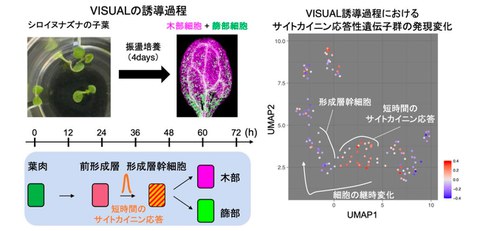
The research group first reanalyzed a dataset from a previous study that applied single-cell transcriptomics to VISUAL, thereby investigating the process at the cellular level with a high degree of accuracy by which cambium stem cells begin to become active. As a result, the researchers found that just before the production of cambium stem cells in VISUAL, the response to the plant hormone cytokinin temporarily becomes stronger (Fig. 2). When this response to cytokinin was suppressed, cambium stem cells were no longer produced.
Fig. 2 Cytokinin response dynamics and cell fate transitions in VISUAL
Single-cell transcriptomics of VISUAL showed that there is a limited increase in cytokinin response at the stage just before the production of cambial stem cells (procambium cells).
Credit: Yuki Kondo
Based on the result, the research group transferred the focus of their analysis to Arabidopsis roots and visualized the cytokinin response by using bioluminescence imaging technique. As a result, it was confirmed that a similar short-term peak in the cytokinin response also appears in the region just before the initiation of radial growth in roots (Fig 3.). It is revealed that this short-term peak in the hormone response acts as a "switch" that initiates the activity of cambium stem cells and leads to the plant's radial growth, by conducting experiments in which the cytokinin response in roots was artificially manipulated.
Fig. 3 Cytokinin response dynamics in Arabidopsis roots
A cytokinin response peak that acts as an activation switch for cambium stem cells was found by bioluminescence imaging of Arabidopsis roots. This response peak (red line) lasted only about 12 hours and shifted location from day to day.
Credit: Yuki Kondo
The research group further investigated how this short-term cytokinin response initiates the activity of cambium stem cells, and found that before experiencing the peak of this response, the cells lack the ability to generate xylem cells, which are essential for stem cell activity and the ability to maintain themselves. It was shown that by experiencing a short-term cytokinin response, cells simultaneously acquire two abilities necessary for future radial growth and activate as cambium stem cells for the first time (Fig. 4).
Fig. 4 Effects of cytokinin and schematic diagram of the research
Unlike normal VISUAL, which induces both xylem and phloem cells, VISUAL without cytokinin only produced phloem cells. The short-term cytokinin response adds the ability to produce and maintain xylem cells, acting as a switch to activate stem cells and prepare to initiate radial growth. Credit: Yuki Kondo
Social Impact of the Research
During the radial growth of plants, xylem tissue, which is an essential resource as woods, and parenchyma tissue, which stores effective chemical components, are produced. The results of this study have clarified the mechanism that triggers this enlargement, and are expected to have a variety of applications, such as improving the efficiency of wood production, developing plants that store effective substances, and even breeding plants that absorb more CO₂.
Notes
The article, “A cytokinin response maximum induces and activates bifacial stem cells for radial growth,” was published in British scientific journal of Nature Plants (online) at DOI: https://doi.org/10.1038/s41477-025-02051-4.