About this research

NAKAI Fumiaki
- Graduate School of Science
- Specially Appointed Researcher (Full Time)

Dislocation glides occur in visible granular media, just like atomic crystals
A single defect can deform the entire granular media even at low stresses
- For the first time in the world, dislocation glides, a deformation mechanism unique to atomic crystals such as metals, was observed in a solid particle aggregate (granular medium).
- By using computer simulations to precisely introduce defect structures based on the theory of microscopic atomic crystals into macroscopic granular system, it was revealed that dislocation glides occur only when the interparticle friction is small.
- It was also discovered that this dislocation glide causes the entire media to deform with lower stresses than in a perfect, defect-free crystalline state.
- This important discovery brought by this research will bridge academic fields of different scales: granular physics which deals with visible particles and atomic crystallography.
- It is expected that the unique property of dislocations, which allows materials to deform in only specific directions with extremely low stresses, will be applied to industrial applications such as the development of new functional materials.
Outlines
A collaborative research group consisting of Specially Appointed Researcher (Full Time) Fumiaki Nakai, Yuto Sasaki (doctor course), Professor Hiroaki Katsuragi of the Department of Earth and Space Science, Graduate School of Science, the University of Osaka, Associate Professor Takashi Uneyama of the Graduate School of Engineering, Nagoya University, and Assistant Professor Kiwamu Yoshii of the Faculty of Advanced Engineering, Tokyo University of Science, has discovered, for the first time in the world, that a unique deformation mechanism known as dislocation glide occurs in granular media (powders) composed of a large number of solid particles.
Dislocation glide is a fundamental phenomenon that occurs when atomic-scale crystals such as metals and semiconductors deform. However, it has not yet been clarified whether a similar phenomenon occurs in granular media consisting of visible solid particles such as sand, food powder, and glass beads, nor under what conditions it occurs or how it affects the deformation behavior (rheology) of the entire media.
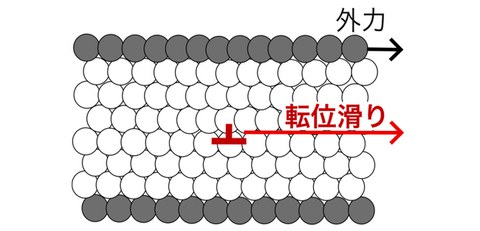
In this study, the research group tackled this mystery using a computer simulation technique called the discrete element method (DEM). Based on the theory of atomic crystals, the researchers intentionally designed a special crystalline granular medium that has only one crystal defect called a "dislocation" (Fig. 1)
As a result of simulating the deformation of this crystal by applying stresses, it was discovered that dislocation glides occur only when the interparticle friction is small. Furthermore, the research group found that dislocation glide causes the entire media to deform with extremely lower stress than in a perfect, defect-free crystal (Fig. 2).
This important discovery brought by the research will bridge academic fields of different scales: granular physics which deals with visible particles and atomic crystallography. In the future, it is expected that the unique property of dislocations, which allows materials to deform in only specific directions with extremely low stresses, will be applied to industrial applications such as the development of new functional materials.
Fig. 1 Schematic diagram of dislocation glide: Defects (dislocations) within a crystal move little by little, like an inchworm, causing the entire media to deform
Credit: Fumiaki Nakai
Research Background
Crystals such as metals and semiconductors undergo flexible deformation due to internal defects (dislocations) moving in sequence in response to external stresses (dislocation glide). This movement is often likened to that of an inchworm. However, it was not known to date whether this dislocation glide occurs in granular media made up of visible macroscopic solid particles, and what the deformation behavior (rheology) of the entire media would be if this were the case.
Most granular media around us have uneven particle sizes and arrangements, and therefore do not have a crystalline structure that allows dislocations to exist. For this reason, research into crystalline granular medium with precisely controlled structures has been extremely limited to date. Therefore, the research group hypothesized that if it was possible to artificially create a structure of crystalline granular media, it could be possible to observe a completely new deformation mode in granular systems called dislocation glide.
Fig. 2 Simulation results of shear stresses (yield stress/Young's modulus of particle) versus interparticle friction coefficient. Results are shown for a defect-free crystal (perfect crystal) and a crystal containing dislocations. When dislocation defects are present, dislocation glide occurs, making the strength much weaker than that of a perfect crystal.
Credit: Fumiaki Nakai
Research Contents
Based on theoretical research from over half a century ago, the research group designed a crystalline granular medium in which particles of uniform size were precisely aligned so that they could contain only one crystal defect called a dislocation (Fig. 1). When stress was applied to this special crystal, it was confirmed for the first time that the dislocation glide observed in micro crystals also occurs in macroscopic granular system. Even more intriguingly, it was found that this dislocation glide occurs only when the interparticle friction is small, and that deformation can be achieved with stress several to several hundred times lower than in a perfect, defect-free state (Fig. 2).
Social Impact of the Research
This research has revealed that dislocation glide, which has been discussed from the perspective of microscopic crystals, can also occur in macroscopic solid particles that can be visible by human eyes. This marks a major step in applying and expanding the microscopic crystal deformation theory which has been vastly accumulated in history, to the macroscopic world of granular particles. Dislocation glide in granular particles is a completely different mode from previously known granular deformation (e.g. flow of random structures or uniform deformation of perfect crystals). In particular, the possibility of using the properties of dislocations to design special dynamic response, such as being extremely weak against stresses from a specific direction, is expected to open the way to industrial applications such as new functional materials.
Notes
The article, “Dislocation glides in granular media,” was published in American scientific journal of Physical Review Letters (online) at DOI: https://doi.org/10.1103/7g7s-c157.