
Achieved highly efficient "Complete Decomposition" of PFAS, which causes environmental problems
A joint research between the Graduate School of Engineering and NexFi Technology that utilized a newly developed high-frequency pulse generator
- Developed a high-voltage pulse generator that enables unprecedented high-frequency operation which enables stable generation of high-density plasma even under high-speed water flow.
- By utilizing this in-liquid plasma, PFAS, which is causing serious environmental problems, was efficiently and completely decomposed.
- PFAS could be decomposed using plasma, but complete decomposition had been difficult, and there was a demand for a technology that could decompose PFAS efficiently and economically.
- The study suggests the possibility of breaking the cycle of PFAS persistence and eradicating it from the environment.
Outlines
A research team consisting of Professor Tsuyoshi Funaki at the Graduate School of Engineering, the University of Osaka (hereinafter referred to as UOsaka), and Takashi Nakamura, president of NexFi Technology Inc. (hereinafter referred to as NexFi) developed a new high-frequency pulse generator and succeeded in efficiently and completely decomposing PFAS (a general term for perfluoroalkyl and polyfluoroalkyl compounds), which are causing serious environmental problems, by utilizing in-liquid plasma with this new equipment.
They set up the SiC Applied Technology Joint Research Course in 2017 and have been conducting research and development toward the social implementation of innovative high-voltage equipment using SiC power devices. This achievement will mark a major step towards solving social problems.
Once released, PFASs are difficult to decompose naturally and tend to remain in the environment while traveling long distances, making PFAS contamination a growing problem around the world. As many countries have tightened restrictions on the use and production of specific PFASs, decomposition technology is being researched as one effective method of dealing with PFAS. However, there are many challenges for full-scale implementation, and it has not yet been put to practical use.
Low-temperature plasma is one of the decomposition technologies that has attracted attention, but current technology has low decomposition efficiency with higher cost, so it has not yet been put to practical use. Complete decomposition was also difficult, and technological advances were required.
In the joint research project with UOsaka, NexFi has developed a high-voltage pulse generator capable of operating at unprecedented high frequencies of up to 1Mpps. By using this pulse generator for low-temperature plasma in liquid, it is now possible to generate stable, high-density plasma even under high-speed water flow. Furthermore, when PFAS was treated with this in-liquid plasma, it was successfully decomposed completely in a significantly shorter time than conventional methods.
This result has demonstrated the possibility of significantly reducing the cost of PFAS treatment and breaking the cycle of PFAS persistence, thereby eradicating it from the environment.
NexFi and UOsaka will continue to conduct research to further improve decomposition speed in order to achieve early social implementation of the technology.
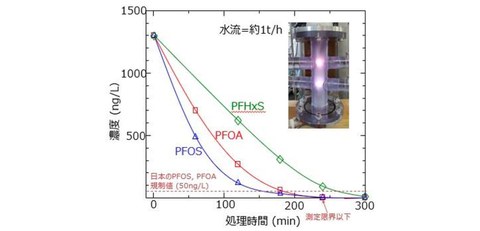
Fig. 1: Complete decomposition of PFAS using in-liquid plasma
Research Background
PFASs are released in various industrial processes of producing products around us, and are hardly decomposed in nature, remaining suspended semi-permanently on land, in rivers, in oceans, and in the atmosphere. Therefore, efficient and complete decomposition methods are required to eradicate them. In addition, its negative effects on humans have been confirmed, and its manufacture, import, and other processes are subject to restrictions under international treaties. So far, PFAS was known to be decomposed using plasma, however, due to issues such as low efficiency (long processing time) and inability to completely decompose (especially short-chain PFAS), it has not yet been put to practical use.
Research Contents
The research group is developing high-voltage, high-frequency switching modules and pulse generators using SiC power devices. This time, by combining SiC power devices with a high-speed pulse transformer developed independently by NexFi, the research team has developed a high-voltage pulse generator that enables unprecedented high-frequency operation of up to 1Mpps. By using this pulse generator for low-temperature plasma in liquid, it is now possible to generate stable, high-density plasma even under high-speed water flow.
As one of the applications of this technology, the research team is also demonstrating the highly efficient decomposition of persistent substances using in-liquid plasma. When the researchers attempted to decompose PFAS, which is a major social problem, they succeeded in completely decomposing it with high efficiency.
Fig. 1 shows the time required to treat PFAS-related substances under high-speed water flow (approx. 1 t/h). Previously, it was difficult to maintain stable plasma under high-speed water flow, and it was not possible to decompose the substances below the regulated value. However, by using the newly developed equipment, PFOS and PFOA were decomposed to below the regulated value in 160 minutes and 180 minutes, respectively, and were completely decomposed to below the measurement limit in 250 minutes. The short-chain PFHxS was also decomposed to below the regulated value in 270 minutes, and to below the measurement limit in approximately 300 minutes.
Further research and development will be continued to improve decomposition efficiency.
(Note: the measurements were carried out by a third-party analysis specialist)
Social Impact of the Research
The results of this research not only provide a clue to resolving the current PFAS problem but also are expected to be widely applied as a solution to air and water pollution caused by persistent organic compounds that are similar sources of environmental pollution.
Notes
Patent information related to the research
Patent application: 2025-97960 (pending)
Applicant: NexFi Technology Inc.
Title of invention: Method for decomposing persistent compounds and in-liquid plasma generator